
Power transformers
Monitoring, protection and digitization for oil-filled transformers and reactors.
From essential to complete monitoring
Each point of the transformer has a dedicated Electron device. Start with the essentials and move to levels 2 and 3 as the asset becomes more critical.
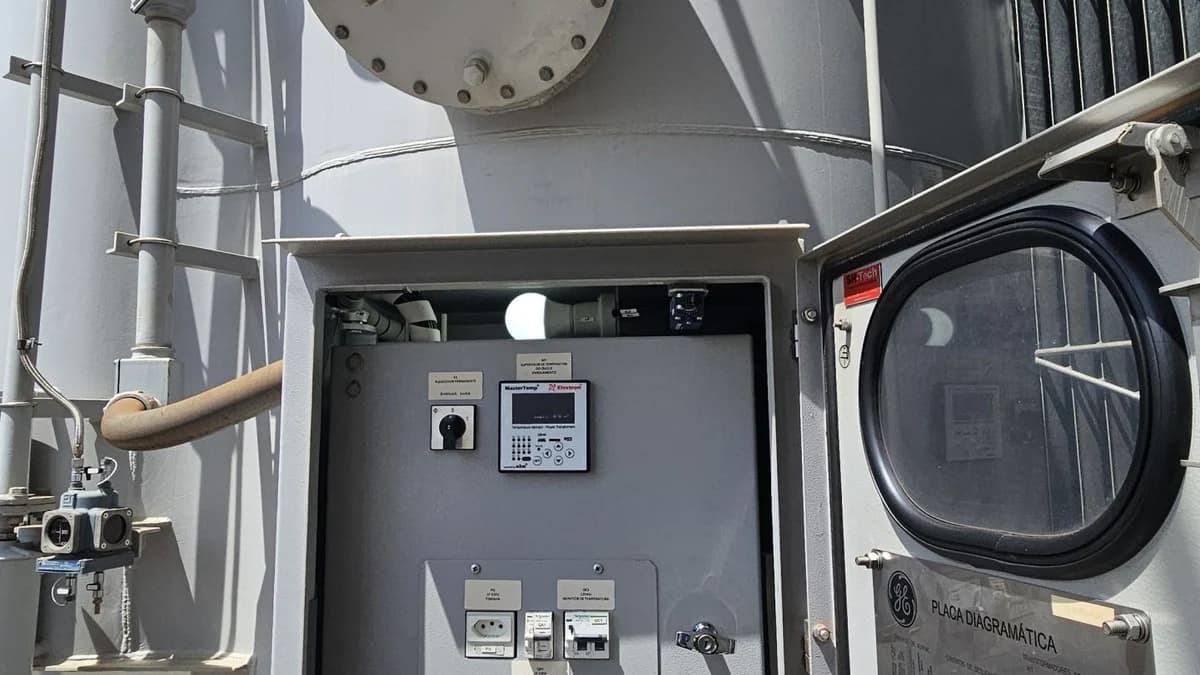
Monitoring levels
What each level covers. A configuration can combine features from all three levels.
| Level 1 | Level 2 | Level 3 | |
|---|---|---|---|
| Oil and winding temperature | ✓ | ✓ | ✓ |
| Oil level | ✓ | ✓ | ✓ |
| Bag or membrane | ✓ | ✓ | ✓ |
| Tap position | ✓ | ✓ | ✓ |
| Tap paralleling | — | ✓ | ✓ |
| Hydrogen (H₂) | — | ✓ | ✓ |
| Non-contact thermal monitoring | — | ✓ | ✓ |
| Tap control and voltage regulation | — | — | ✓ |
| Moisture and pressure | — | — | ✓ |
| Digitization and integration through the RTU | — | — | ✓ |
Monitoring points on the transformer
Oil and windings
Oil temperature and up to three windings, with hot spot, permissible loading and loss of life.
Tap changer and tap position
Local and remote position indication, paralleling, control and voltage regulation for on-load tap changers.
Ventilation and radiators
Fan groups switched by programmed limits and thermal differential at the radiator inlet and outlet.
Expansion tank and corrugated tank
Oil level with high and low alarms, bag or membrane integrity and liquid level in corrugated tanks.
Buchholz relay and pressure relief valve
Alarm contact multiplication and alarm latching until the operator intervenes.
Gases, moisture and pressure
Hydrogen (H₂) and temperature; the GDSCAN 6200 also adds moisture and pressure.
Digitization and integration
The RTU gathers signals and sends events and measurements to the supervisory system.
Reliability and availability
Oil-filled transformers are essential to power transmission and distribution at medium and high power ratings. Their performance depends on tracking temperature, oil level and condition, gases, pressure, cooling and tap changing. Electron intelligent electronic devices (IEDs) help identify anomalies at an early stage and support maintenance planning.
Windings and thermal condition
Winding monitoring uses calculations based on NBR, IEC and IEEE standards to indicate hot-spot temperature, permissible loading, loss of life and remaining life. MasterTemp monitors oil and up to three windings; MoniTemp Plus monitors oil and one winding. This information supports operation, maintenance and replacement decisions.
Custom monitoring
The configuration can combine features from levels 1, 2 and 3 to suit the application. Contactless thermal monitoring, described for Thermocube, allows tracking of critical points and heating trends. Data integration supports condition-based maintenance and intervention planning.
Need help choosing?
Talk to our team and find the right solution for your application.